
Upper Allen Township Directory Collections
Upper Allen is a township, not an incorporated city with a verified continuous commercial directory series. Its residents have appeared under Mechanicsburg, Camp Hill, Harrisburg, rural-route, or county descriptions, and a title for a nearby place can omit part of the Township. The dependable starting point is therefore a Cumberland County and Mechanicsburg-area historical shelf. Confirm a book's title, place coverage, and dates before drawing a conclusion about a particular household.
| Collection | Years | Where Held | Access |
|---|---|---|---|
| CCHS town directories and school yearbooks | Years/runs not verified, ask catalog/archivist | Gardner/Hamilton Library, Cumberland County Historical Society | Visit and catalog consultation |
| Obituary and marriage surname cards | 1785–1870 | CCHS genealogy research service | Research-request route |
| Census indexes | 1790–1860 named by CCHS | CCHS | Research-service source |
| Tax records | 1750–1930 in CCHS service | CCHS and Cumberland County Archives | Repository and archival listings |
| Gardner Digital Library | Ongoing collection | Gardner Digital Library | Public online community-history search |
That restraint matters. It prevents an unverified neighboring book from becoming a claimed Upper Allen run. The CCHS catalog or an archivist can identify whether a needed town or reverse directory is actually on the shelf.
Upper Allen Township Records Scope
A historical household search often crosses several custodians. The Township creates municipal records, while Carlisle offices keep county land, court, estate, and archival material. For an old family question, the county's public-records routes can establish which office has a deed, estate file, tax source, or historical register. Those sources support a dated fact. They do not create a master list of everyone who lived in Upper Allen Township.
The Cumberland County public-records and documents page is a useful starting point for the county-held layers behind an Upper Allen Township directory search.
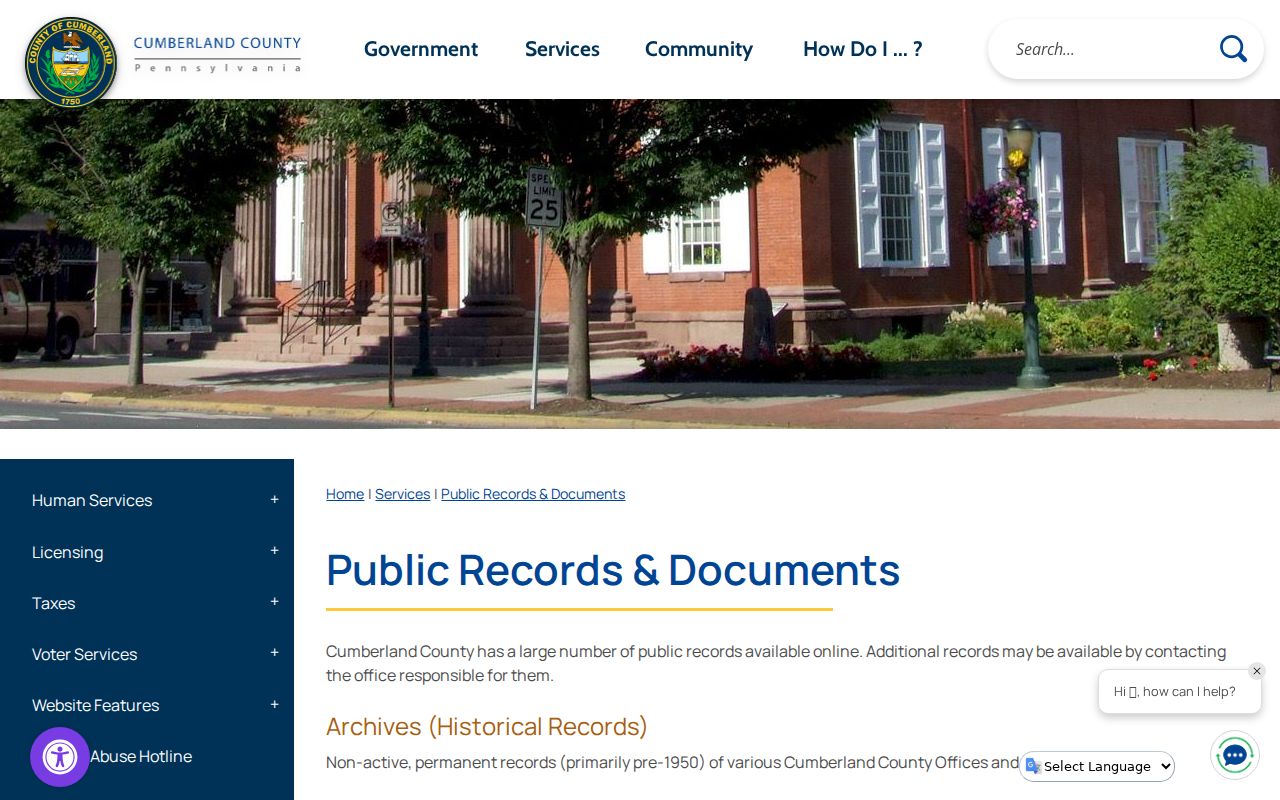
Use the County page to choose the proper office, then preserve the repository, record date, and exact source beside any directory-style clue. A postal label alone is weaker than the record's own township or parcel reference.
CCHS and Upper Allen Township Directories
The Cumberland County Historical Society's Gardner/Hamilton Library at 21 N. Pitt Street in Carlisle is the local historical shelf for this work. Its closed-stack archival library has more than 40,000 published volumes and original documents and manuscripts. The stated holdings include genealogy and family files, county histories, business records, church and cemetery sources, newspapers, and Carlisle Indian Industrial School material. Manuscript and photograph collections use PastPerfect and other finding aids, and staff or volunteers are available during open hours.
The access choices matter as much as the collection. Nonmembers pay a $5 daily research-room fee, while students and members do not. A Cumberland County Library System cardholder may borrow the CCHS/CCLS pass from any county library branch and use CCHS resources without that entry fee. Copies cost $0.50 per page and personal-camera use costs $5 per visit. The Cumberland County Library System collections page is the practical first stop for the library-branch side of that pass.
When travel is not possible, CCHS offers genealogy research for a surname or family question. Its request service searches defined historical sources, but it specifically does not generally trace property history or search the federal census. A house question belongs with the Recorder or Archives; a family connection may fit the CCHS request route.
Reading an Upper Allen Township Directory
No official local source supplied a scanned Upper Allen directory entry and abbreviation key. That means a sample should not be invented. When CCHS confirms a relevant book, photograph or transcribe the heading and the key along with the line itself. A standard directory normally moves from surname to address. A reverse, or criss-cross, arrangement moves from address to the printed occupant line. Either can contain old spellings, initials, rural-route wording, or a nearby postal place.
| Printed name | Record initials, surname spelling, and every punctuation mark as published. |
|---|---|
| Address line | Capture house number, street, rural route, post-office label, or business address exactly as printed. |
| Family notation | Note spouse or widow wording only when the book prints it, then corroborate with another source. |
| Occupation or employer | Record this line only if it appears. It is a historical identifier, not proof of a present connection. |
| Marks and key | Save the page's abbreviation key. Do not assume a symbol means owner or renter unless the key defines it. |
- Criss-cross directory
- An address-ordered portion of a directory that can lead from a printed address to a listed occupant.
- Householder index
- An index that groups a household's printed head or heads. Confirm the book uses one before relying on it.
- Abbreviation key
- The publisher's explanation of shortened labels and symbols, often near the front of a volume.
Check adjacent years. A missing line can reflect a move, a changed postal label, a subdivision change, or an editorial choice. Census, tax, deed, and obituary records are the needed checks before calling the same-named person a match.
Upper Allen Township Directory Comparison
A surname directory and a criss-cross directory answer different questions. The first may help move from a printed name to an address. The second may help move from an address to the name printed for that year. CCHS has not published a verified local title-and-year list for either form, so availability must be checked before using the comparison. Neither format proves occupancy or legal residence by itself.
| Starting point | Possible result | Best confirmation |
|---|---|---|
| Surname in a confirmed town directory | Printed address, route, or local association | Census, tax record, deed, obituary, or estate file dated near the entry |
| Address in a confirmed criss-cross book | Printed occupant line for the publication year | Parcel and deed history for land, plus household sources for people |
| Township tax entry | Taxpayer under Upper Allen Township organization | Exact tax year, volume, page, spelling, and a separate parcel or family record |
Note: A directory title and a postal city are research leads, not substitutes for the municipality printed in the underlying record.
CCHS Cards for Upper Allen Families
CCHS's early-newspaper obituary and marriage surname cards cover 1785–1870. They can connect a surname seen in a book, tax source, or census to a death or marriage notice. The same research service lists genealogy and manuscript cards, county histories and biographical annals, census indexes for 1790–1860, a will index for 1750–1937, will abstracts for 1750–1825, tax records for 1750–1930, church and cemetery records, and an estate-inventory index.
The paid service charges $40 for members and $50 for nonmembers. A request asks for the surname, known dates, the Cumberland County connection, prior research, and the particular question. Supply only supported facts and state whether the goal is a family, obituary, marriage, cemetery, will, or tax lead. The form's limit on property-history work is important, because a land chain needs Recorder and Archives evidence instead of a surname-only request.
The alphabetized CCHS Church and Cemetery Index can also identify the specific church or cemetery source behind a surname. It points to a publication or record set, rather than promising a complete grave record for every name.
Tracing Upper Allen Township City Directories
Build a household trail in a fixed order so a single printed name does not carry too much weight. Begin with the earliest confirmed surname clue and retain the original spelling. Then place that person in the township and time period before joining the result to a parcel, estate, or obituary. The sequence below uses the historical sources CCHS and Cumberland County offices actually document.
- Search the CCHS surname, obituary, marriage, church, cemetery, or genealogy catalog route for a defined name and time period.
- Check the federal census nearest the period. CCHS identifies census indexes from 1790 through 1860, and public federal schedules are released after 72 years.
- Use a township tax source to place the person in Upper Allen. Record the volume, page, tax year, and spelling exactly.
- Test land or inheritance clues through the Recorder and Register of Wills, keeping legal descriptions separate from a modern street number.
- Ask CCHS whether a town or reverse directory exists for the needed year, then transcribe its entry and abbreviation key.
- Close the question with a newspaper notice, probate file, cemetery source, or later dated record that fits the same person.
A household can disappear from a directory because it moved, died, went unlisted, or appeared under a different place name. Upper Allen's Mechanicsburg postal identity makes that last possibility especially important. For modern address-keyed work, use the Upper Allen Township street records route instead of forcing a historical shelf to answer a current parcel question.
Upper Allen Township Historical Record Map
The oldest record trail is not organized around today's street numbers. Cumberland County formed from Lancaster County on January 27, 1750. A pre-1750 family connection in the present Upper Allen area may therefore be in Lancaster County records. After formation, county tax lists, deeds, estates, church material, and newspapers create a much deeper trail than a modern address label suggests.
- Before 1750: the future Cumberland territory belonged to Lancaster County for archival purposes.
- 1750 onward: Cumberland tax lists, Recorder deeds, and Register estate and Orphans' Court sources begin their documented county-era coverage.
- 1894–1906: Cumberland Register holdings provide a local birth-and-death record bridge.
- 1950: the latest public decennial individual federal census at the research date can help bridge family and location evidence.
Upper Allen later changed from a largely rural landscape into a suburbanizing township. The legal land history can be old even where a current subdivision address is much newer. Record the jurisdiction and date beside every result.
Upper Allen Township Archives Access
The Cumberland County Archives is the county's separate historical fallback for inactive permanent records, generally from before 1950. It is at 310 Allen Road Annex in Carlisle. Its online Local Listings route can show holdings, and unscanned material requires an appointment. Public hours are Monday from 10:00 a.m. to 4:00 p.m. or by appointment, so a catalog search should come before travel.
The Cumberland County Archives public-access page describes the online listings and the appointment path for materials that are not scanned.
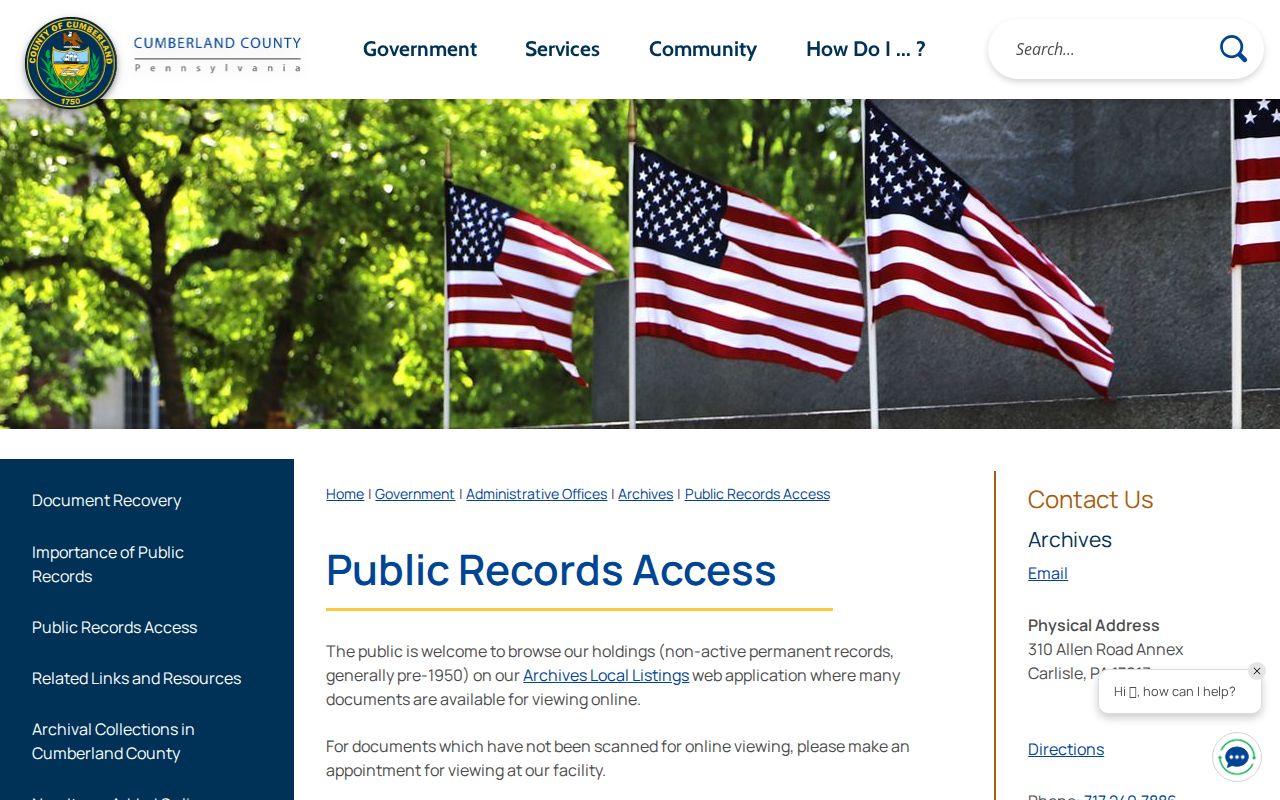
For township-era tax research, select the Commissioners record group, then Tax Rate Books, use Holdings to identify a volume, and choose its camera image when one is available. Early books can be difficult to read. A taxpayer is not automatically a landowner or the resident of a particular modern parcel.
Upper Allen Township Records Requests
When an existing Township-held permit, plan, meeting record, or decision is not available online, Pennsylvania's Right-to-Know Law provides a narrow request route. The statute is Act 3 of 2008, 65 P.S. §§ 67.101–67.3104. Direct the request to the agency most likely to hold the record and name the address or parcel, date range, document category, and preferred electronic format. The law reaches existing public records, subject to exemptions and redaction. It does not require an office to make a household history or a new index.
The Pennsylvania Office of Open Records provides the current Agency Open Records Officer finder, request guidance, fee information, and appeal resources.

An agency ordinarily responds within five business days. A proper interim response can extend the expected date, normally no later than 30 calendar days after that initial period. Ask for a defined record rather than a conclusion about a person or family.
The Office of Open Records explanation of the Right-to-Know Law also describes the law's requester and access framework.
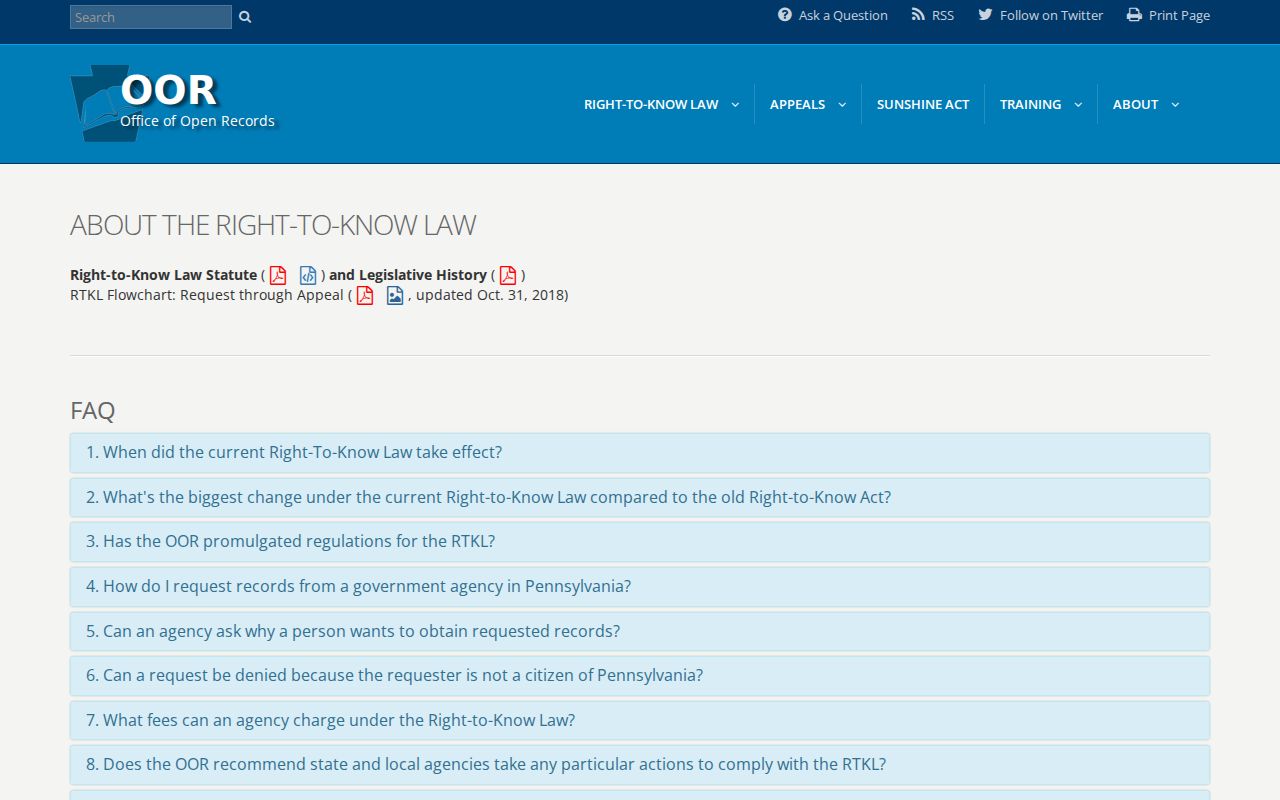
That process complements, rather than replaces, a catalog search at CCHS or the County Archives. Historical collections are often located through the repository that holds them, while a request is best for a specific existing government record.
Upper Allen Township Community Memory
The Gardner Digital Library adds oral histories, photographs, family connections, named streets, schools, and local community material to the formal record trail. It is useful for learning how a place or family was remembered. It is not proof of identity, current address, or legal residence. Pair a story or photograph with a dated tax, census, deed, estate, church, cemetery, or newspaper record before making a family-history conclusion.
That distinction gives Upper Allen research its proper shape: a wide historical shelf, careful confirmation, and no invented directory run.